2008 Litters

2007 Litters

Applying for a kitten

Taking your kitten home

Personality

Health

About us

Bonnie's six week old kittens
^ Bonnie's kittens, six weeks old. (January 2008)
Three kittens 2007

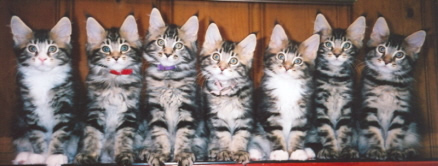
^ From Madeline and Wonder's "New Seven Wonders" litter (pictured at the top of the page). Taj Mahal, Chichen Itza, Machu Picchu, fourmonths old

Kittens on small tree

^ Kittens are very ground-bound at first. They start by climbing onto small cat trees.

Nine kittens on cat tree

Based on their age, we know how high kittens will climb. Once they make it to the top, we put pillows around the base and rugs for them to grab while they develop their leaping and climbing skills.
Windwalker Blue Thunder 2005
Windwalker Blue Thunder - 2005 Thunder lives in Denmark and has produced many beautiful kittens.
Ruby 10 weeks
Windwalker Ruby Toesday - ten weeks old (2000)
Sophie, sister of Ruby at left, ten weeks old (2000)
Sophie, Ruby'a sister, 10 weeks old.


A Kitten from us

Our kittens go to you vaccinated, spayed or neutered, microchipped and guaranteed negative for FIV and FeLV. We show you how to keep claws short and provide the scratch pad they need, so you won't have problems with your furniture. (See What's included with our kittens.)

We raise kittens with three guiding principles: socialization, early handling and environmental enrichment. Our kittens are loved and handled from the day they are born. They stay with their mom and littermates in our bedroom until they're vaccinated. then they run around our house, which is a playground of toys and climbing places.

During the kittens' first four months with us they're held, hugged and played with constantly. At 16 weeks, when they're self-confident and ready, we find them an incredible home. Hopefully, your kitten will be with you for 15 to 20 years, so these weeks with their first family are worth it!

Applying for a Windwalker kitten

We are a small cattery and only have three or four litters a year. We work with you to see that the personality of your kitten matches your home environment and lifestyle.

We evaluate kittens for show or pet quality when they are 12 weeks old, then we check with people that have a kitten from us already, and then we review email requests we've received. You may email us and introduce yourself. The more you tell us about yourself, your home, your family and other pets, the better we can match the personality of the kitten to your home.

Please do not be offended if we ask you lots of questions, as our kittens go to people with whom we share similar values and priorities about pet ownership.  We are happy to answer your questions as well. When the kittens are available, we invite you to our home to see our cats. (If you just want to see lots of Maine Coon cats and kittens, we suggest you go to a cat show. Maybe we'll see you there!)

back to top

Taking your Kitten Home

You'll want to take your kitten home in a medium-sized carrier. (Your cat will be in a carrier whenever it is in a car, so buy a medium-sized carrier that will last.) Every kitten leaves here with the food it's been eating, a favorite toy, a pad with the smells of home and buddies, nail clippers, brush, and toothbrush.  

We don't ship cats in cargo, so if you would like one of our kittens, and you don't live close to us, we will discuss arrangements for travel or refer you to a Maine Coon breeder closer to your home.

When you take one of our kittens, our understanding with you is that it is with you for life. If things change and you can't keep your cat, let us know and we'll help you find it another home. Please call us if you have a question on your cat's behavior or health.

back to top

Health Matters

We breed Maine Coons because we want to protect and preserve this wonderful breed.  We want our kittens to live long healthy lives so our breeding males and females are screened for two genetic conditions found in some Maine Coons: Hypertrophic Cardiomyopathy (HCM) and hip dysplasia (HD). All our breeding cats are negative for the cMYBPC-3 mutation (what does this mean?).

Of course, the best way to ensure your cat lives a long time is to keep it indoors with you, so we have an indoor-only requirement.   Declawing, which is amputation, is not allowed.   (If you have questions, here is a page of information and links on early spay and neutering and declawing.)

back to top

Personality

We believe our cats' affectionate, intelligent personalities come from their parents, so we use only gentle, outgoing cats for breeding. Our kitten owners attest to the results! We especially see the charm and warmth of our stud male, Wonder, in his litters. Click here for a summary of a Cambridge University study that supports our observation.

The cMYBPC-3 mutation

DNA negative means our cats have had a cheek swab sent for DNA testing and the results were negative for the cMYBPC-3 mutation that may lead to Hypertrophic Cardiomyopathy (HCM). HCM is not specific to a breed of cats, it's found in household pets and pedigreed cats, but with a pedigreed cat, a reputable breeder that's paying attention uses every tool that's available to ensure their cats will not develop the disease.

With Maine Coon cats we're very fortunate that in 2006 a genetic marker was identified for one of the most common causes of HCM. For several years, cardiac ultrasound screening has been the recommended method of identifying and reducing the incidence of this disease, and we still do this also.

No breeder can guarantee that their cats will not develop HCM. but we can use all the available tools to identify the cause. Our efforts are our continued commitment to your kitten buyers to try to breed healthy and sound Maine Coon cats to the best of our ability. This means that we will not breed cats that are positive for the cMyBPC-3 mutation, and we will continue to have our cats' hearts ultrasounded by Dr. Lori Siemens, a certified California veterinary cardiologist here in Sacramento.

For more information about HCM, visit this excellent site: http://members.aol.com/jchinitz/hcm/

back to top

HCM - Hypertrophic Cardiomyopathy


HCM is a disease of the heart muscle. The cMYBPC-3 mutation genetic mutation causes abnormal proteins to be created which in turn result in abnormalities at the cellular level. Heart muscle is comprised of specialized muscle cells. As the disease progresses, it frequently results in structural and dynamic changes in the heart that can eventually be detected on echocardiogram (ultrasound).

The heart is a dual pump which pumps blood to the lungs for oxygenation, and subsequently pumps the oxygenated blood into the body's circulatory system. The contractions that cause the heart to pump are regulated by the heart's "electrical" system ... its own natural pacemaker and conduction system. This conduction system is comprised of specialized fibers that conduct the electrical signals throughout the heart muscle. While the minute details of the physiological sequence of events that result in sudden death in cats (or people) who have HCM (whether detectable on echo or only by histopathology) are unknown, there is no doubt whatsoever that the disease abnormalities in the muscle tissue can cause a disturbance in conduction, and that sometimes the disturbance is lethal.

back to top


Copyright © 2008 Windwalker Maine Coons - All rights reserved. | Updated 4/26/08 | Contact Us